

Signals
We help teams
see trouble early and act together.
Signals exists so support, success, product and revenue teams stop finding out about churn when it hits the forecast and start steering it while there is still time.
Why we built Signals
The churn problem is not a lack of data. It is a lack of signal.
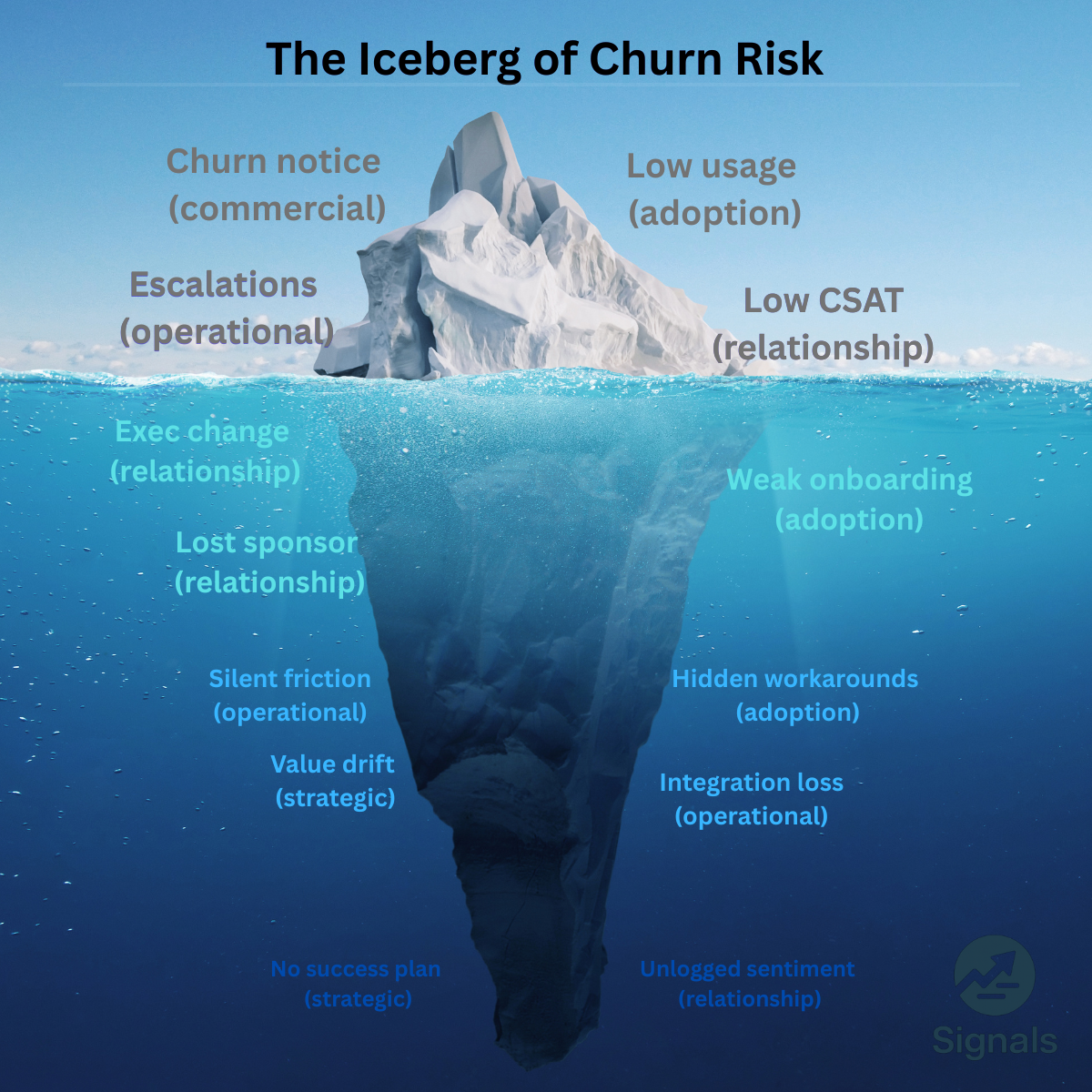
Every company is drowning in data. CRM fields, ticket tags, feature flags, leadership changes, renewal notes, usage dashboards. None of it lines up in one place where people can make fast, confident decisions.
Too often, teams only join the dots when a renewal is already on fire. By then, the champion has moved on, ticket volume has been heavy for months, product has missed the pattern and finance is asking why this was a surprise.
Signals turns that noise into a single stability view. It pulls behaviour, sentiment and events into an explainable score so everyone can see where risk is building, what is behind it, and what to do next.
Signals started as a frustration inside customer and support leadership roles. Too many war rooms. Too many spreadsheets. Too many “we should have seen this coming” moments.
The first version was a scrappy internal model to rank accounts by risk based on real behaviour, not gut feel. It worked. Teams calmed down. Reviews improved. So we turned it into a product.
Today, Signals is being shaped with design partners across support, success and revenue operations who want a cleaner way to keep customers stable and green.
How we think about customer health
Health is not a single score. It is the story of how a relationship is behaving over time.
Evidence over narrative
We bias to behaviour, not stories. Tickets, usage, leadership changes and conversations all count. Opinions are welcome, but they sit on top of the data, not instead of it.
Context over vanity metrics
Dashboards without context create noise. Signals explains why a score moved, not just that it did, so conversations shift from “what happened” to “what do we do”.
Action over anxiety
A health model is only useful if it tells people what to do next. Every signal should point to an owner, a plan and a path back to green.
How we got here
Our journey so far
Signals grew out of years of running support, success, and cx teams. We kept seeing the same blind spots, so we built a product that exposes them early and gives every team a shared view of risk.
Why Signals exists
Every churn story has a timeline. Champions leave, product fit drifts, usage falls, and nobody joins the dots until renewal is already at risk.
Signals is our attempt to wire those dots together: one place where risk shows up early, is easy to explain, and comes with a clear way back to green.
Pattern spotting
The same risks, in every team
Years of leading support, success, and cx teams showed the same failure modes on repeat: no shared view of risk, late escalations, and health scores nobody trusted.
Experiments
Manual scoring and “back to green” plans
We started with spreadsheets, playbooks, and signal catalogues. The approach worked, but it was slow, fragile, and hard to keep aligned across support, success, product, and revenue teams.
Signals today
A shared early-warning system for revenue
Signals pulls in events from your stack, turns them into explainable health scores, and generates back-to-green plans your team can actually run. Less guessing. Fewer surprises. More accounts staying green.
Built with operators, for operators
Signals is not a generic BI tool. It is a health and stability layer shaped with people who live the day to day of keeping customers and revenue safe.
If you run support, success, revenue or operations and you care about seeing risk early, we would like to build this with you, not just for you.
Who we are
Signals is founded by people who have run support and customer experience teams, not just built software. We have sat in the QBRs, run the incident calls and owned the renewals.
That experience shapes how we prioritise, what we automate, and the standard we hold the product to.
If you want to help shape the roadmap or explore working together, get in touch.
Ready to see Signals on your data?
Start with a personalised demo or a free 30-day trial. See how Signals turns early customer risk into clear next steps for your team.
Free 30-day trial available. Design partner is optional.